The Empire State Building Gets Hit by Lightning 25 Times Per Year — So Much for 'Never Striking Twice'
We've all heard the phrase tossed around in casual conversation: "Lightning never strikes the same place twice." It's become our go-to metaphor for beating impossible odds, landing that dream job against all expectations, or experiencing any kind of unlikely second chance. But as a statement about actual weather patterns, this folk wisdom is spectacularly, measurably wrong.
The Empire State Building alone gets struck by lightning roughly 25 times per year. Some particularly tall structures see lightning strikes multiple times during a single storm. And if you really want to see the phrase demolished by raw data, consider that the CN Tower in Toronto gets hit about 75 times annually. Clearly, lightning has never read the folklore about its supposed behavior.
How a Weather Myth Became Life Philosophy
The saying's origins trace back to folk observations that seemed reasonable enough. In rural areas, people noticed that lightning strikes appeared random and scattered. A barn hit by lightning one year might sit untouched for decades afterward, while strikes seemed to find new targets each storm season. Without understanding the physics involved, it made intuitive sense that lightning would avoid repeating itself.
This observation gradually evolved from a rough rule of thumb into something approaching natural law. By the time it entered popular culture, "lightning never strikes twice" had transformed from a casual observation about weather patterns into a confident statement about probability and fate. The phrase became shorthand for the idea that extremely unlikely events don't repeat themselves.
But folk wisdom developed in an era before skyscrapers, radio towers, and meteorological radar. The lightning that rural observers saw was striking relatively low, randomly distributed targets across varied terrain. Modern infrastructure has fundamentally changed the lightning game.
What Lightning Actually Does
Lightning follows the path of least electrical resistance from storm clouds to the ground, which means it consistently favors the same types of targets: tall, pointed, conductive objects in open areas. This isn't random behavior — it's physics doing exactly what physics always does.
Skyscrapers, radio towers, mountaintops, and isolated trees create ideal conditions for lightning strikes. They extend closest to storm clouds, providing shorter paths for electrical discharge. Once a structure establishes itself as the tallest point in an area, it becomes a lightning magnet that will attract strikes year after year, storm after storm.
The National Weather Service has documented this pattern extensively. Tall buildings in lightning-prone areas don't just get struck repeatedly — they get struck predictably. Engineers designing these structures plan for regular lightning strikes, installing sophisticated protection systems specifically because they know the strikes will keep coming.
The Empire State Building's Electric Show
New York's most famous skyscraper has become an inadvertent laboratory for lightning behavior. At 1,454 feet tall and standing in one of the most lightning-active regions of the country, it serves as a massive lightning rod for Manhattan. The building's lightning protection system handles dozens of strikes each year without incident.
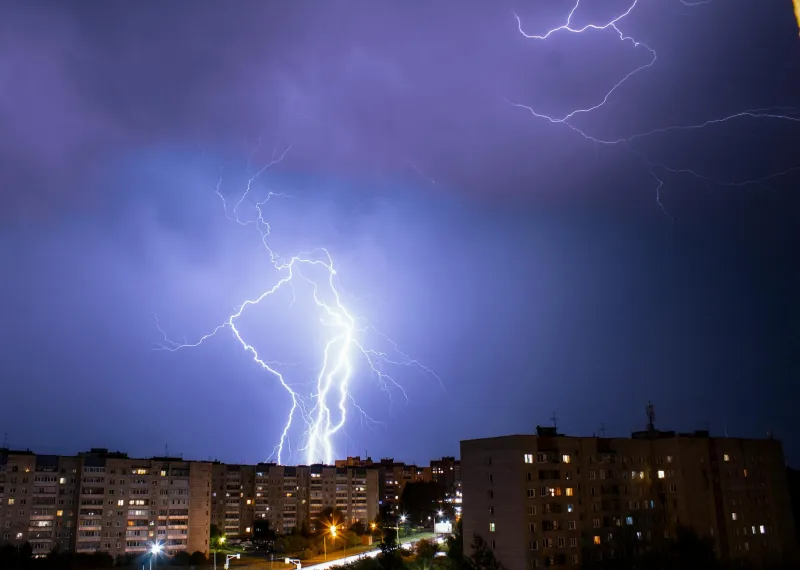
Photographers have captured stunning images of the building being struck multiple times during single storms, with electrical bolts creating dramatic light shows against the Manhattan skyline. These aren't freak occurrences — they're annual events that happen with such regularity that weather enthusiasts plan photography sessions around them.
The building's lightning rod system, installed during construction in the 1930s, was designed specifically because engineers knew the structure would be struck frequently. They weren't hedging against an unlikely possibility; they were preparing for a meteorological certainty.
Why Tall Objects Become Lightning Magnets
The physics behind repeat lightning strikes is surprisingly straightforward. Lightning forms when electrical charges build up in storm clouds, creating a massive voltage difference between the cloud and the ground. The electrical discharge follows the path that offers the least resistance, which almost always means the shortest route available.
Tall structures reduce the distance that lightning needs to travel, making them the most attractive targets in any given area. A 1,000-foot building essentially reaches 1,000 feet closer to storm clouds than surrounding ground-level objects, dramatically increasing the probability of a strike. This advantage doesn't disappear after the first strike — it exists during every subsequent storm.
Mountaintops and ridgelines follow the same pattern. The highest peaks in mountain ranges get struck far more frequently than surrounding areas, sometimes multiple times per storm. Weather stations on mountain summits regularly record dozens of lightning strikes per year, with some locations seeing strikes during every significant thunderstorm.
The Folklore That Refused to Die
Despite overwhelming evidence from meteorology, the "never strikes twice" saying has proven remarkably resistant to correction. Part of this persistence comes from the phrase's metaphorical usefulness. Even people who understand that lightning actually does strike the same places repeatedly continue using the expression because it captures something meaningful about probability and second chances.
There's also a confirmation bias at work. In most landscapes, lightning strikes are genuinely scattered and random-seeming. The vast majority of lightning hits relatively low targets — trees, houses, open ground — that don't create obvious patterns of repeated strikes. The spectacular examples of repeated strikes on tall buildings represent a small fraction of total lightning activity, making them easy to overlook in casual observation.
Additionally, the saying predates our modern understanding of electricity by centuries. When the phrase first gained popularity, people had no scientific framework for understanding why lightning behaved the way it did. Folk wisdom filled that knowledge gap with explanations that seemed logical based on limited observations.
Modern Lightning Science
Today's meteorologists understand lightning behavior with remarkable precision. Weather radar can track storm cells and predict which areas face the highest strike probability. Lightning detection networks monitor electrical activity in real-time, mapping thousands of strikes across the country every day.
This data reveals clear patterns that folk wisdom missed. Urban areas with tall buildings see concentrated lightning activity around the highest structures. Mountain regions show consistent strike patterns along ridgelines and peaks. Even individual trees in open areas can become repeat targets if they're significantly taller than surrounding vegetation.
Lightning protection systems for buildings and infrastructure are designed around the assumption of repeated strikes. Engineers don't install these systems to guard against a single unlikely event — they're preparing for regular, predictable electrical activity that will continue as long as the structure stands.
The Real Odds of Lightning
While lightning definitely strikes the same places repeatedly, that doesn't mean individual people need to worry about being struck multiple times. The odds of any specific person being struck by lightning in a given year are roughly 1 in 1.2 million. The odds of being struck twice remain extraordinarily low for individuals who don't regularly expose themselves to lightning-prone situations.
However, people who work outdoors in high-risk occupations — park rangers, construction workers, farmers — do face elevated risks of multiple strikes over their careers. A few individuals have been documented surviving multiple lightning strikes, though these cases remain extremely rare and usually involve people whose jobs or lifestyles create repeated exposure.
Why the Truth Matters
Understanding real lightning behavior has practical implications beyond correcting folk wisdom. People living near tall structures should understand that those buildings will attract lightning strikes, potentially affecting nearby electrical systems. Outdoor workers need accurate information about lightning risks to make informed safety decisions.
More broadly, the lightning myth illustrates how appealing folk wisdom can persist long after science has moved on. In an era of rapid technological change and complex global challenges, distinguishing between metaphorically useful sayings and literally accurate information becomes increasingly important.
The next time you hear someone mention lightning never striking twice, you'll know the real story. Lightning strikes the same places repeatedly by design, not by coincidence. The Empire State Building's annual light show proves it, and physics explains why it will keep happening as long as storms roll through New York City.